Back to overview
11/06/2026
As soon as the first warm days arrive, sandals reappear in the streets. Parents are often faced with the same choice: do you go for a model with an open toe or rather a closed variant? It’s a question that comes up regularly, but in practice the answer is less black and white than it sometimes seems.
With children’s sandals, it is not so much about what is “better”, but rather about what feels good, fits well with your child’s foot and matches how and where the sandals will be worn.
Before even looking at open or closed styles, it is important to first focus on the fit. A sandal can look beautiful, but if it does not fit the foot properly, it will never truly be comfortable.
Every child has a different foot shape. Some children have narrow feet that require a model that is slim and nicely wraps around the foot. Other children have wider feet, where a broader model is needed to provide enough space and comfort without creating pressure points. This is not a detail, but the foundation of a good sandal choice.
When the fit is right, a large part of the open vs. closed discussion already becomes irrelevant.
The difference between an open and a closed sandal is often presented as bigger than it actually is. In essence, it mainly comes down to appearance, feeling and personal preference, both from the child and the parent.
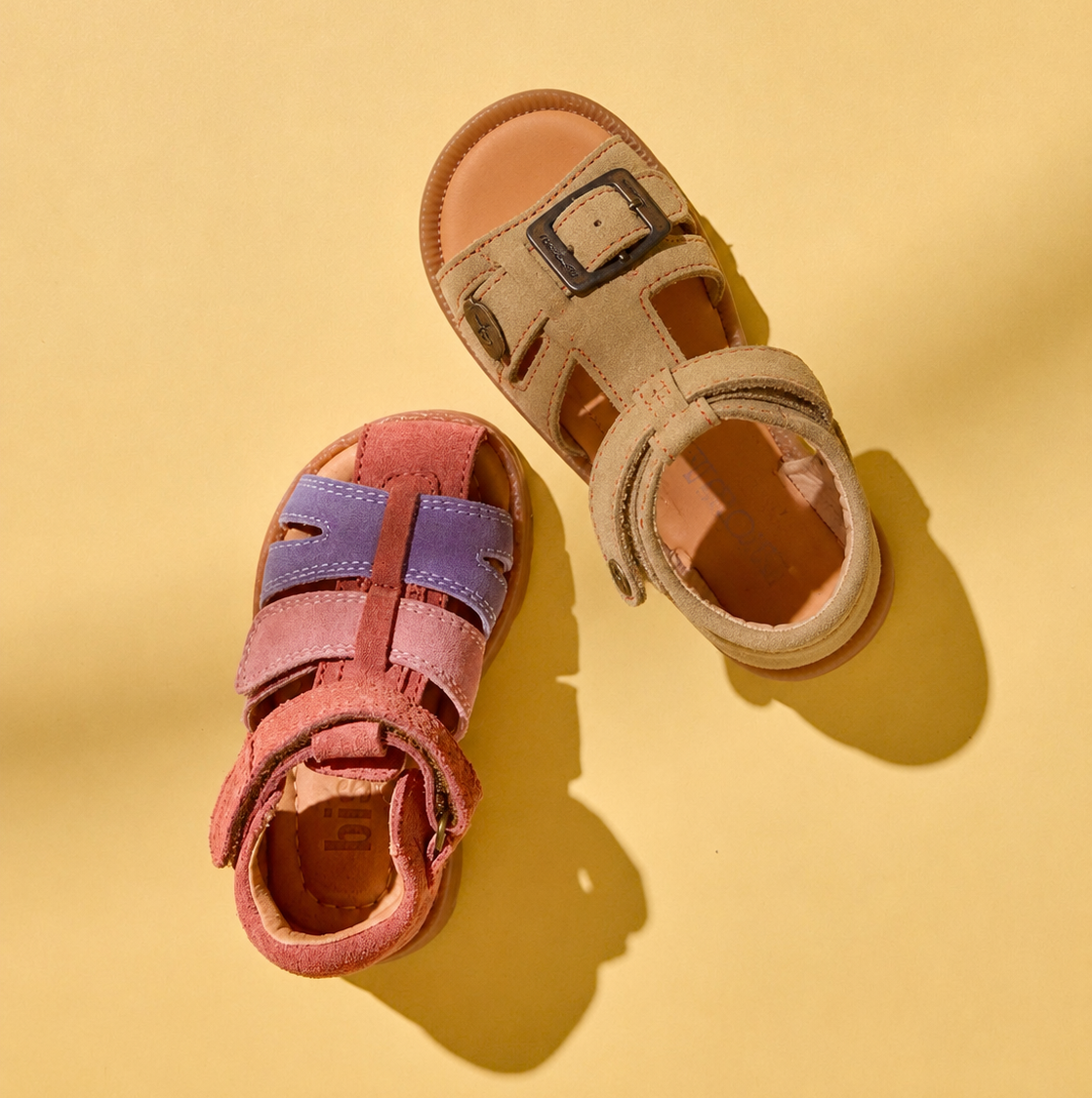
Open sandals are often associated with warm summer days, and not without reason. They give an airy feeling and look light and summery, which is also simply appealing to many children.
It is important to understand that “open” does not mean the foot is completely unprotected. With a well-fitting sandal, the sole always extends beyond the toes, meaning the toes are not truly exposed or vulnerable in normal situations. The foot remains naturally protected while walking, playing and exploring.
Another practical advantage is that open sandals often handle small inconveniences more easily. For example, a little stone or grain of sand that ends up in the sandal will usually fall out on its own while walking, without needing to take the shoe off.
Closed sandals have a somewhat stronger and more robust appearance. The toes are partially or fully covered, which simply feels more comfortable for some parents and children.
This extra coverage can provide a small amount of additional protection against bumps or active play. However, the differences are subtle, as even a closed sandal remains in essence a lightweight summer shoe rather than a sturdy closed shoe.
For many families, it therefore mainly comes down to taste and preference. Some children find a closed model cooler or more stylish, while others prefer the airy feel of an open sandal.
In daily use, you mainly notice practical nuances rather than major differences.
Open sandals often feel a bit freer and airier, especially during warm days or long periods of outdoor play. In addition, you are less likely to experience small stones getting stuck.
With closed sandals, it can sometimes happen that something ends up inside the shoe that does not come out as easily. This does not mean it is a disadvantage, but it may mean the sandal needs to be taken off briefly to restore comfort.
Still, the conclusion here is quite simple: neither option is fundamentally better than the other. It mainly depends on how intensively and where your child will wear the sandals.
What many parents often pay less attention to, but what is in practice far more important, is the material of the sandal.
Leather breathes and feels soft, which means the foot is less likely to sweat and stays much more comfortable while walking. Because the material regulates moisture better and the skin stays less hot and damp, you also get far fewer blisters. With synthetic materials it is the opposite: they cause the foot to sweat more easily and create a combination of heat, moisture and friction, leading to a much higher risk of blisters, skin irritation and discomfort.
A practical detail that sometimes comes into play is wearing socks with sandals. With closed models, it is more common to wear a thin sock on cooler days. This can be comfortable and allows the sandals to be used even in slightly colder weather.
With open sandals, this is less common, as visually and in terms of feel it usually does not match the typical summer look children prefer.
The choice between open or closed sandals is less of a technical debate and much more a matter of preference, use and feeling. Open sandals offer a light, summery experience and are often practical in daily use. Closed sandals have a slightly more robust appearance and provide subtle extra toe coverage. But in the end, what matters most is something else entirely: a perfectly fitting sandal for your child’s foot. Combine that with high-quality leather and you have the foundation for a sandal in which children can move freely, comfortably and worry-free all summer long.
 Our customers give us an average rating of 4,7/5 stars